RCD vs RCBO Consumer Units
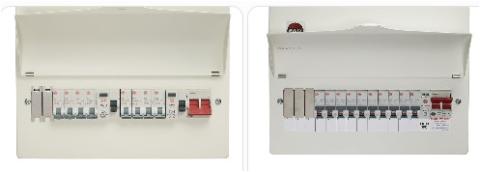
When upgrading an older electrical installation, one of the questions homeowners often ask is whether they should choose an RCD consumer unit or an RCBO consumer unit.
Both can provide important protection against electrical faults, but they work differently and can affect how individual circuits are protected.
In this guide, we explain the difference between RCD and RCBO consumer units and what to consider when choosing a new consumer unit for your home.
What Is an RCD?
RCD stands for Residual Current Device.
An RCD monitors the electrical current flowing through a circuit and can disconnect the supply if it detects an imbalance that indicates current may be flowing to earth.
RCD protection can help reduce the risk associated with electric shock and certain electrical faults.
A traditional RCD consumer unit may use one or more RCDs to protect groups of circuits.
What Is an RCBO?
RCBO stands for Residual Current Breaker with Overcurrent protection.
An RCBO combines residual-current protection with overcurrent protection for an individual circuit.
This means that each protected circuit can have its own RCBO rather than several circuits sharing RCD protection.
For example, a property could have separate RCBO protection for circuits such as:
- Lighting
- Socket outlets
- Cooker
- Shower
- Washing machine
- Outdoor electrical equipment
The exact arrangement will depend on the property's electrical installation and the design of the consumer unit.
RCD Consumer Units vs RCBO Consumer Units
The main difference is how the circuits are protected.
With a consumer unit using shared RCD protection, several circuits may be connected behind the same RCD.
If a fault causes that RCD to operate, multiple circuits can lose their power.
With an RCBO consumer unit, each circuit can have its own combined residual-current and overcurrent protection.
If one circuit develops a fault, its RCBO can disconnect that circuit without necessarily disconnecting the other circuits.
This can make fault identification easier and can reduce the number of circuits affected by a fault.
Advantages of RCBO Consumer Units
One of the main benefits of an RCBO arrangement is individual circuit protection.
Better circuit separation
If a fault occurs on one circuit, the protection for that circuit can operate independently of the others.
Easier fault finding
Because an individual RCBO relates to a particular circuit, identifying which circuit has operated can be more straightforward.
Reduced nuisance disruption
A fault on one circuit is less likely to cause several unrelated circuits to lose power.
This can be particularly useful for important circuits such as refrigeration, lighting or external equipment.
Flexible protection
RCBOs can provide both residual-current and overcurrent protection for individual circuits, depending on the type and specification installed.
Are RCD Consumer Units Still Suitable?
An RCD-based consumer unit can still provide effective protection when properly designed and installed.
However, the most appropriate consumer-unit arrangement depends on the existing installation, the number and type of circuits, the earthing arrangement, the condition of the wiring and the requirements of the electrical installation.
An electrician should assess the installation before recommending an upgrade.
Simply replacing an old fuse board with a new consumer unit isn't necessarily enough. The existing electrical installation should be assessed and the new equipment selected and installed appropriately.
Which Is Better: RCD or RCBO?
There isn't a universal answer.
An RCBO consumer unit can offer greater individual circuit separation, which can be particularly useful where avoiding unnecessary loss of power to other circuits is important.
However, the correct solution depends on the individual property and electrical installation.
A qualified electrician can assess the installation and explain the available options, including the type of protection appropriate for each circuit.
When Should You Consider a Consumer Unit Upgrade?
You may want to have your consumer unit assessed if:
- You have an older fuse board
- Your consumer unit has no suitable RCD protection
- You regularly experience unexplained tripping
- You're renovating or extending your property
- You're adding new electrical circuits
- You're installing an EV charger or other high-demand equipment
- You're buying an older property
- You're concerned about the condition of your electrical installation
An inspection can determine whether an upgrade is necessary and what type of consumer unit would be appropriate.
Feel free to contact us for a FREE quotation.